Sometime in 1998 | Secaucus, NJ | One balmy Jersey summer evening, at the tender age of three, my Aba took me for a walk under the stars. A muscular, Jason Statham type with an ex-IDF edge, my father had a strange knack for dropping poetry mid-chaos. “Look, Zeza,” he said — his nickname for me. “You see the stars? God cut holes in the blanket he puts over us at night so we know he’s there.” A subtle nod to The Lion King, my then-favorite film. Everything the light touches, eh, Doron?
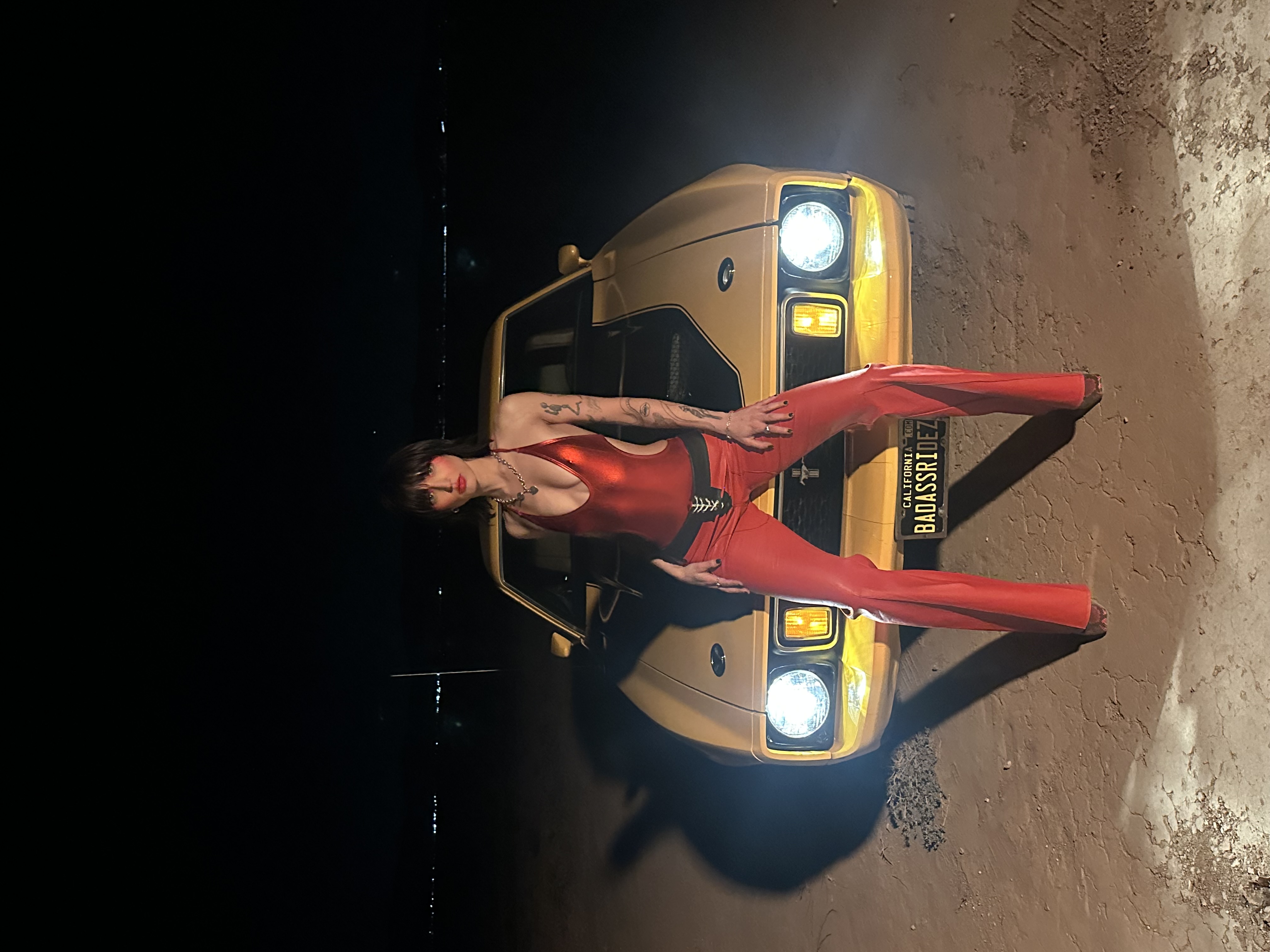
November 4, 2024 | Lancaster, CA | Twenty-six years later, delirious from no sleep, somewhere on the outskirts of the Mojave, covered in dirt, stomach empty, lungs full, I looked up at those same stars and felt it again. Behind me, two rented ’60s muscle cars. In front, three demons, a goblin, a funeral pyre, and a wiry director shouting for more rage. Something about the moment felt inevitable. Familiar. I was moved to tears, but my makeup looked too good to ruin, so instead I choked them back and listened to what the feeling was trying to say.
March 31, 2025 | Yonkers, NY | The older I get, the more I feel how deeply my lens is shaped by inheritance, both sacred and absurd. Long after the fever-dream one-day shoot, hunched over my laptop and fueled by cheap coffee, I started recognizing a pattern, a tone, a cadence. One I’d felt before — in synagogue and Hebrew school, endless Mizrahi Shabbat dinners that started at 8:30pm, bland kugel and sumptuous dag morocait, and somehow also in the media that quietly haunted me: An American Tail, Russian Doll, BoJack Horseman, or anything touched by the likes of Lou Reed or Leonard Cohen. These works don’t shout their Jewishness; they smuggle it in through structure, through skepticism, through a kind of holy exhaustion with the world’s logic, a poetic sense woven almost imperceptibly throughout like a sort of cosmic inside joke.
I’ve started calling it covert Judeofuturism. It’s not a genre, manifesto, or palatable guidelines for an inclusivity bingo card, but a vibration: the ghost of a rabbinical argument inside a sci-fi screenplay, an ethical dilemma no one solves, memory with its wires crossed. Judeofuturism doesn’t need a bima, or even public recognition. It hides in plain sight, cracking a joke while pointing at the void.
Take Severance, for example: a show ostensibly about workplace ethics and late-capitalist alienation, but humming with the rhythms of diaspora trauma woven through themes of enforced amnesia, sanctified bureaucracy, and performative cheer in the face of dread. It all felt familiar in a way I couldn’t articulate until I looked up the credits (Jewish, many of them). This felt not significant in the checkbox way, but in a tonal, existential one. There’s something profoundly Jewish about a narrative that centers forgetting as survival, that builds a metaphysical system around compliance, and still finds a way to smuggle in a question, a joke, a rebellion.
Similarly (or inevitably?) I didn’t set out for Illionaire to be a meditation on justice, determinism, or Jewish identity, but like most meaningful things in my life, it arrived that way anyway. I wrote the song in the throes of a private emotional catastrophe, after being ghosted by someone I thought I could trust. The anger was too expansive, too amorphous to confront head-on, and was really a stand-in for other things I’d yet to confront about myself, so it found its way out sideways — disguised as swagger, wrapped in vengeance, dressed like a fight I could win.
When I sent the song to Brandon Bernath, a filmmaker I’d just started getting to know, he came back with a treatment so intuitively aligned with the track that it truly startled me. He’d only heard it once, but conjured a fully-formed mythic narrative: leather-clad demons, a goblin getaway driver, muscle cars barreling across the desert like beasts in heat. I told him we "draw from the same well," and I still believe that.
Well, somehow while discussing the shoot, we discovered that we’re both Jewish. Maybe that explains why the story didn’t need shaping. It was already there. We just had to follow it. It was shot entirely in a single day, against the clock, against the elements, against reason. It felt impossible, and yet certain.
There’s no Yiddishkeit in the visual aesthetic, no Torah scrolls, sacred symbols, coded language. Yet the spiritual architecture — the tension between ego and justice, the staging of harm and quiet, absurd repair — feels unmistakably Jewish, not in a didactic sense, but in tone and structure. At the end credits, after we burn Illionaire at the stake, I return Dottie the Pony’s stolen pacifier to her owner Bindi. The binky was tragically lost when Illionaire yanked it outta Dottie’s mouth after Bindi wouldn’t go on a date with him. The story arc, the camp of the characters, and the final redemptive gesture is all so ridiculous and sincere that it becomes sacred. That’s covert Judeofuturism: redemption in miniature, a myth of justice tucked inside a fever dream.
We never spoke about making something Jewish. We didn’t have to. The logic was already in the telephone — strange, precise, inevitable.
Yes, that word I keep using. I’ve come to believe all good art feels inevitable, not in a mystical sense, but in how it resists linear logic, refuses to be reasoned away. Judaism, too, is a tradition of resistance: to simplicity, to clean answers, to singular truths. It’s a lineage of friction, of multiplicity, of staying in the question long after everyone else has chosen a side. We don’t crave resolution — we crave the right kind of argument, for in it could be an important discovery. Of what? Who knows. But it’s best to be constantly searching than idle and mentally complacent. I find rhythm and meaning in the movement.
In that way, Judeofuturism, covert or otherwise, isn’t about representation or even identity, but rather tone, structure, the sacred right to contradict yourself. It’s a future imagined not through efficiency or technological supremacy, but through ritual, absurdity, and defiant hope; the belief that meaning is something you build, brick by brick, in exile, through noise.
I don’t set out to make work that declares itself Jewish, but it’s in the rhythm of my stories, in the questions I can’t stop circling, in the logic I trust more than the plot. That same sensibility pulls me toward others. I was recently connected with a Jewish music lawyer and another Jewish musical artist, both through a mutual friend (Italian from South Brooklyn; same corporation, different division, as we say). These relationships are new, but they already feel inevitable. Trustworthy. Important. Like we’re tuned to the same frequency without needing to explain why.
This retroactively named concept of Judeofutirsm isn’t something I was taught. I’ve tried my best to put words to it, but perhaps it’s better to leave you with the feeling: scattered, resonant, quietly luminous, a constellation I was (and G-d willing, always am) always moving toward.